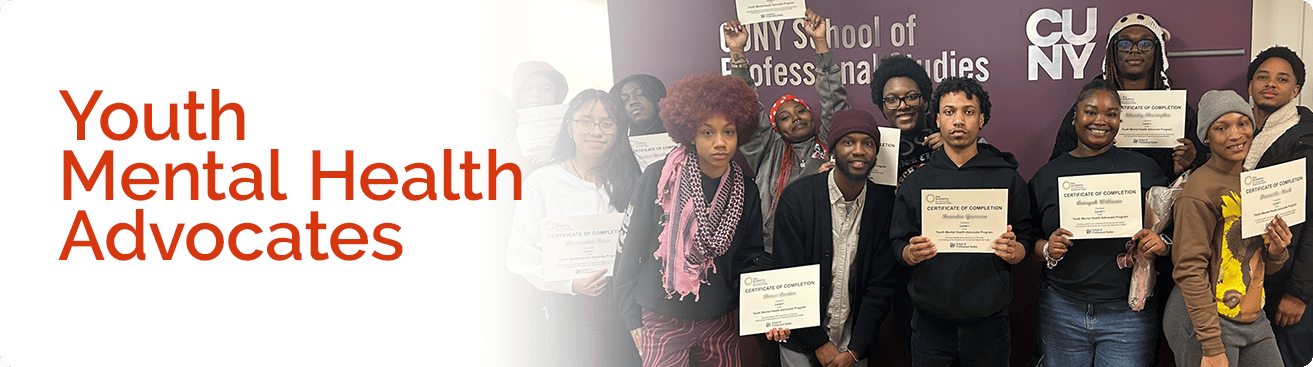
The Youth Mental Health Advocate (YMHA) program is designed to advance the:
• personal and professional development of Youth Advocates;
• availability of youth-centered mental health supports;
• capacity of NYC community-based organizations; and,
• development of NYC’s mental health and social services workforce.
» Our Approach
» Our Principles
Our Approach
Learn more about YMHA’s holistic, multi-component approach:
Advance the personal and professional development and well-being of Youth Mental Health Advocates.
YMHA is designed to support Youth Advocates’ own mental health, growth, education, and employment.
The personal and professional development of Youth Advocates are primary goals of this program. By investing in the well-being and skillfulness of helpers, we also strengthen compassionate, community-based care.
Youth Advocates receive:
- A fellowship stipend of $10,000 that enables YMHAs to meet their needs and participate in this intensive learning and work experience.
- Skills and supports to care for their own mental health, a core emphasis of the Academy’s YMHA curriculum.
- 100+ hours of applied skills training and coaching from the Academy. YMHAs learn in a peer cohort designed to foster meaningful and supportive relationships, experiential learning, progressive skill development, and professional identity formation.
- Part-time work experience in a youth-serving community-based organization, with supportive supervision.
- Free college credits.
- Support to identify and take a next step in their education and career.
- Access to specialized supports, including help with: material needs, mental health care, college admissions assistance, and career advising and job placement.
Increase the capacity of youth-serving community organizations and expand youth-led mental health supports.
Drawing on shared cultural and community experiences and specialized skills, YMHAs enhance a CBO’s capacity to engage and serve young people.
With support from the Academy, YMHAs learn to initiate conversations about mental health and provide help to young people the CBOs serve in 1:1 conversations and groups. Youth Advocates ages 18-24 provide “near-peer” support to younger people, typically between ages 10-18. They also contribute their unique lenses as young people to the CBO team, helping CBOs refine care approaches, policies, and practices.
During pilot implementation (2023-2025), YMHAs helped CBOs deliver accessible, culturally congruent mental health and social support, such as programs to affirm body image among young women of Color, explore the impacts of marijuana and video game use, celebrate diverse gender identities, and more. CBOs reported that YMHAs increased youth engagement across programs.
Core YMHA SkillsYMHAs spend at least 75% of their time delivering youth mental health support, with training and coaching from the Academy. This includes:
|
, |
Other YMHA ContributionsYMHAs make other contributions (up to 25%) based on their skills and interests, CBO priorities, and CBO capacity to provide training and support. Prior YMHA contributions have included:
|
Strengthen the NYC mental health and human services workforce.
YMHA creates a pathway to helping professions for young people who have a deep desire to be of service — along with valued perspectives, experiences, talents, and connections to community-based organizations — but who face barriers to entering the field.
Addressing Barriers
YMHA proactively invites young people who are impacted by the social, economic, and health-related hardships that CBOs seek to address into professional roles serving their communities.
Barrier |
Strategy |
|
| Economic insecurity and a pressing need to earn income
|
YMHA fellowship stipend of $10,000 | |
| Limited or no prior work experience in the field
|
Co-create a YMHA role with youth-serving CBOs and Youth Advocates
Provide YMHAs with applied skills training in competencies that CBOs value. This includes support to step into a professional helping role and navigate the transition from CBO service recipient to helper, where applicable Part-time work in a CBO |
|
| Challenges to personal health and well-being
|
Dedicated support and check-ins from caring adults across the Academy and CBO teams
Training in skills for mental wellness and self-care Access to flexible, specialized supports, including for mental health care and help meeting essential material needs |
|
| No college degree; not currently enrolled in college
|
Meaningful work experience in a role designed for young people without a college degree
Free college credits |
|
| Limited access to information about career paths
|
Guidance from the Academy and CBO supervisors
Exposure to diverse NYC community-based organizations and career paths Support to identify a next step in their career Post-fellowship job placement support |
|
| Fears and challenges around enrolling or re-enrolling in college
|
College advising and admissions support
Help with financial barriers to enrollment (e.g. application fees, bursar holds) |

Our Principles
YMHA aims to address rising youth mental health needs and disparities in their full context. Principles that inform our work include:
Apply a Developmental Lens
YMHA addresses the unique developmental transitions, challenges, opportunities, and joys that young people and adolescents experience.
YMHA’s fellowship model emphasizes the learning, professional development, and mental wellness of Youth Advocates as they navigate emerging adulthood. It also provides YMHAs with a path to apply their lived expertise, skills, and desire to help other young people.
Address social, economic, environmental, and political realities that shape mental health
Youth mental health is influenced by a range of factors, including social, economic, environmental, and political realities that can either harm or help mental health.
Often, community-based organizations both witness and address harms of racism, discrimination, disinvestment, and inequality, including through direct service, advocacy, and place-based community building or preservation.
Through their work in CBOs, YMHAs learn to understand and address mental health in the context of relationships, places, systems, and situations that shape young peoples’ experiences.
Center the agency and capabilities of young people and those who care for them
YMHA centers the strengths, insights, and aspirations of young people and youth-serving community organizations.
We nurture these capabilities by attending to inner resources, interpersonal skills, peer and intergenerational relationships, and participatory program design methods that promote learning, connection, and improved wellness across YMHAs, their host organizations, and the young people they serve.
Use participatory design
Through continual testing, refining, and expanding participatory design methods, we seek to honor the insights of Youth Advocates, community-based organizations, and other stakeholders. Together, we aim to develop a program model that is relevant, feasible, and effective.
The Academy integrates participatory design into the development, pilot implementation, and ongoing improvement of the YMHA model.
In Pilot Year 2 (2024-2025), for example:
- YMHAs completed over 100+ qualitative reflection logs
- The Academy facilitated 8 monthly co-design workshops with YMHAs
- CBO supervisors participated in focus groups, 1:1 conversations, and reflection forms
During the YMHA Design Year (2025-2026):
- 7 former YMHAs accepted roles as consultants to validate themes and lessons from the first two pilot years and test prototypes of future program materials
- CBOs completed a focus group and survey to react to design year findings and recommendations and weigh in on key program decisions